The Dance Between God and Humanity by Bruce K. Waltke
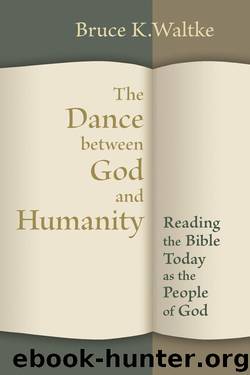
Author:Bruce K. Waltke [Waltke, Bruce K.]
Language: eng
Format: epub
Tags: REL006080
ISBN: 9781467439244
Publisher: Wm. B. Eerdmans Publishing Company
Published: 2013-09-05T00:00:00+00:00
A God-Centered Life
Evangelicals will agree, I suggest, that foundational to loving God is faith in him, fear of him, and repentance before him. In this conviction they stand in marked contrast to the contemporary world.
Pannenberg notes that since the time of the literary figure Jean Paul (1763-1825) and the philosopher G. W. F. Hegel (1770-1831) people have talked about the absence or death of God.6 In 1957, Pannenberg continues, Gabriel Vahanian used the phrase “the death of God” for his analysis of contemporary culture. What is meant by this talk is not a metaphysical thesis about the nonexistence of God but the irrelevance of God, the lack of experiencing God, in concrete experience. Modern secular culture, at least as it is represented by the news media, thinks it gets along quite well without God. Armed with technology based on scientific descriptions of the material and social universes, modern society aims to affect life and control the environment against the risk and contingencies of death and chaos. Modern man, who has expelled God from his universe, thinks he has achieved a relatively high measure of security in individual life through science, technology, and social engineering.
Contemporary theologians reinforce the contemporary vox populi. Pannenberg also notes that dialectical theology by its emphasis on the absolute transcendence of God, existential theology by its denial that God is approachable as a being in himself, and Paul Tillich by his theory that God is absorbed into the world by disappearing into its “depth” — as well as other contemporary notions about God — all deny the possibility of a personal relationship with the God of Scripture.7
As a result modern culture and secular man have lost both God and meaning, sure values, and stable communities. Modern man, emancipated from God’s revelation and traditional institutions, including the church and family, is profoundly afraid of the future and lonely in the present. Pannenberg elaborates upon the consequences of loneliness.
As a consequence of this increasing experience of loneliness, fewer persons are able to develop a sense of personal identity in the course of their individual lives, and that entails the spread of neurosis. At the end of such a journey into loneliness there emerge the recourse to violence and error on the one hand, and the resort to suicide on the other.8
Download
This site does not store any files on its server. We only index and link to content provided by other sites. Please contact the content providers to delete copyright contents if any and email us, we'll remove relevant links or contents immediately.
The Five People You Meet in Heaven by Mitch Albom(3619)
The Secret Power of Speaking God's Word by Joyce Meyer(3404)
Real Sex by Lauren F. Winner(3060)
Name Book, The: Over 10,000 Names--Their Meanings, Origins, and Spiritual Significance by Astoria Dorothy(3008)
The Holy Spirit by Billy Graham(2999)
0041152001443424520 .pdf by Unknown(2890)
How The Mind Works by Steven Pinker(2856)
ESV Study Bible by Crossway(2809)
Ancient Worlds by Michael Scott(2719)
Churchill by Paul Johnson(2633)
The Meaning of the Library by unknow(2624)
The ESV Study Bible by Crossway Bibles(2575)
The Gnostic Gospels by Pagels Elaine(2560)
MOSES THE EGYPTIAN by Jan Assmann(2448)
Jesus by Paul Johnson(2406)
City of Stairs by Robert Jackson Bennett(2397)
The Complete Dead Sea Scrolls in English (7th Edition) (Penguin Classics) by Geza Vermes(2310)
The Nativity by Geza Vermes(2248)
Ancient Near Eastern Thought and the Old Testament by John H. Walton(2241)
